Nirapod Probaho (AegisFlow)
AI-orchestrated multi-agent disaster resilience and relief distribution platform.
1. Problem Context & Objectives
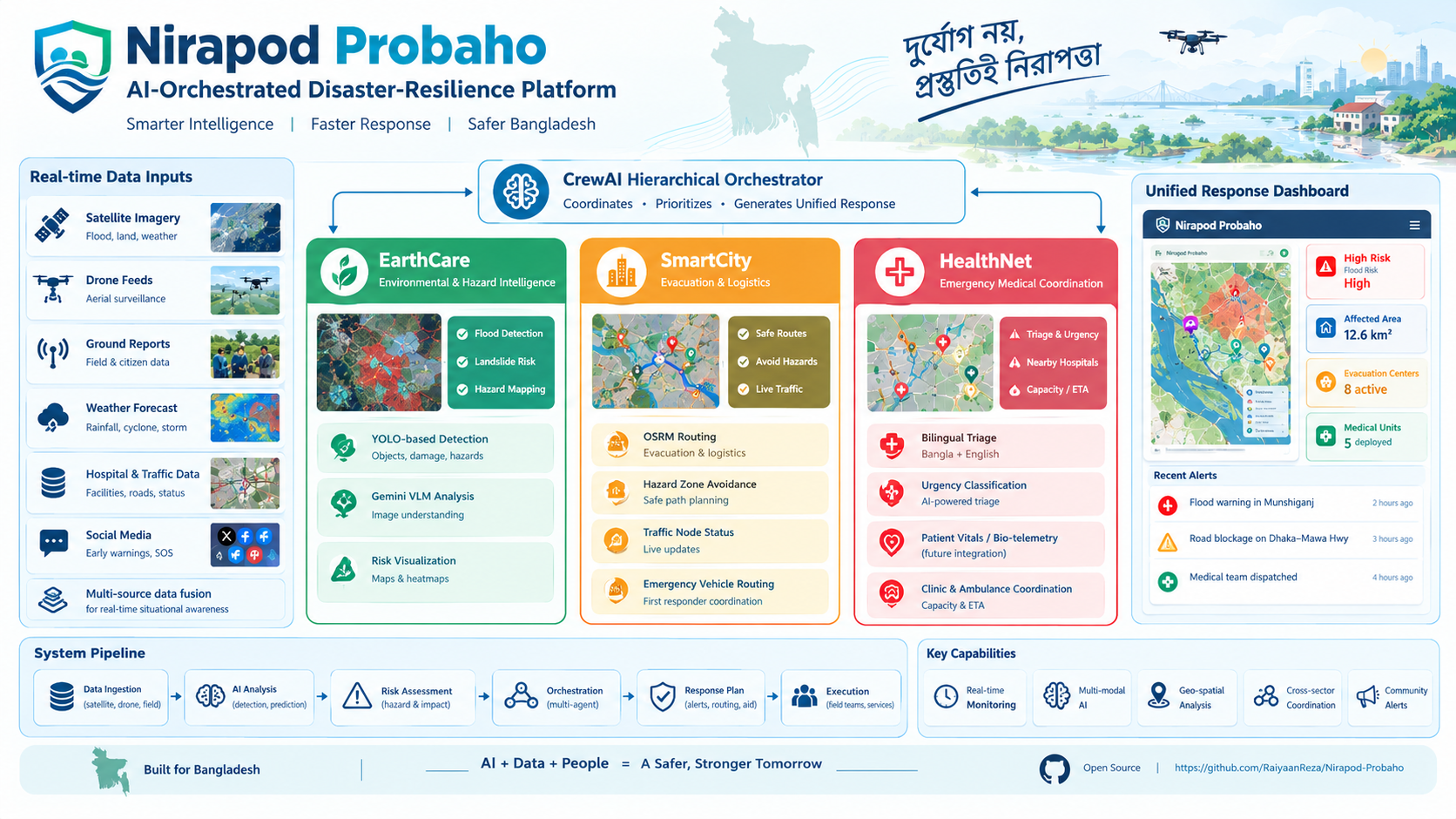
During floods, Bangladesh's relief effort is a coordination problem as much as a logistics one: field reports are slow, volunteers are dispatched manually, and agencies work in silos. Every hour of delay in routing a boat, a medic, or a relief truck costs people their homes, their harvests, or their safety. There was no unified platform that turned scattered signals (satellite imagery, traffic nodes, clinic status) into a single operational picture.
2. Technical Architecture & Implementation
Architected a hierarchical multi-agent system: a CrewAI coordinator manages three mission agents — EarthCare (satellite/flood intelligence), SmartCity (dynamic evacuation routing over OSRM + PostGIS), and HealthNet (bilingual medical triage) — all rendered live on a MapLibre tactical map. Built a bilingual (EN/BN) HUD, real-time Supabase sync, budget-aware Gemini wrapper, and a command palette for rapid incident response.
3. Outcomes, Benchmarks & Empirical Validation
Presented the disaster-resilience prototype at the InnovativeX Hackathon at BUBT in 2025, placing in the Top 10. The system combines multi-agent coordination with geospatial routing to visualize shelters, clinics, and relief routes.
Source Code Inspection & Local Replication
This system is maintained in an open-source repository with full git commit history, environment configuration templates (.env.example), and dependency manifests.