TRACE-BN: Transferring Bangla-English Tutoring Behavior to a Sub-1B Offline Language Model
Abstract
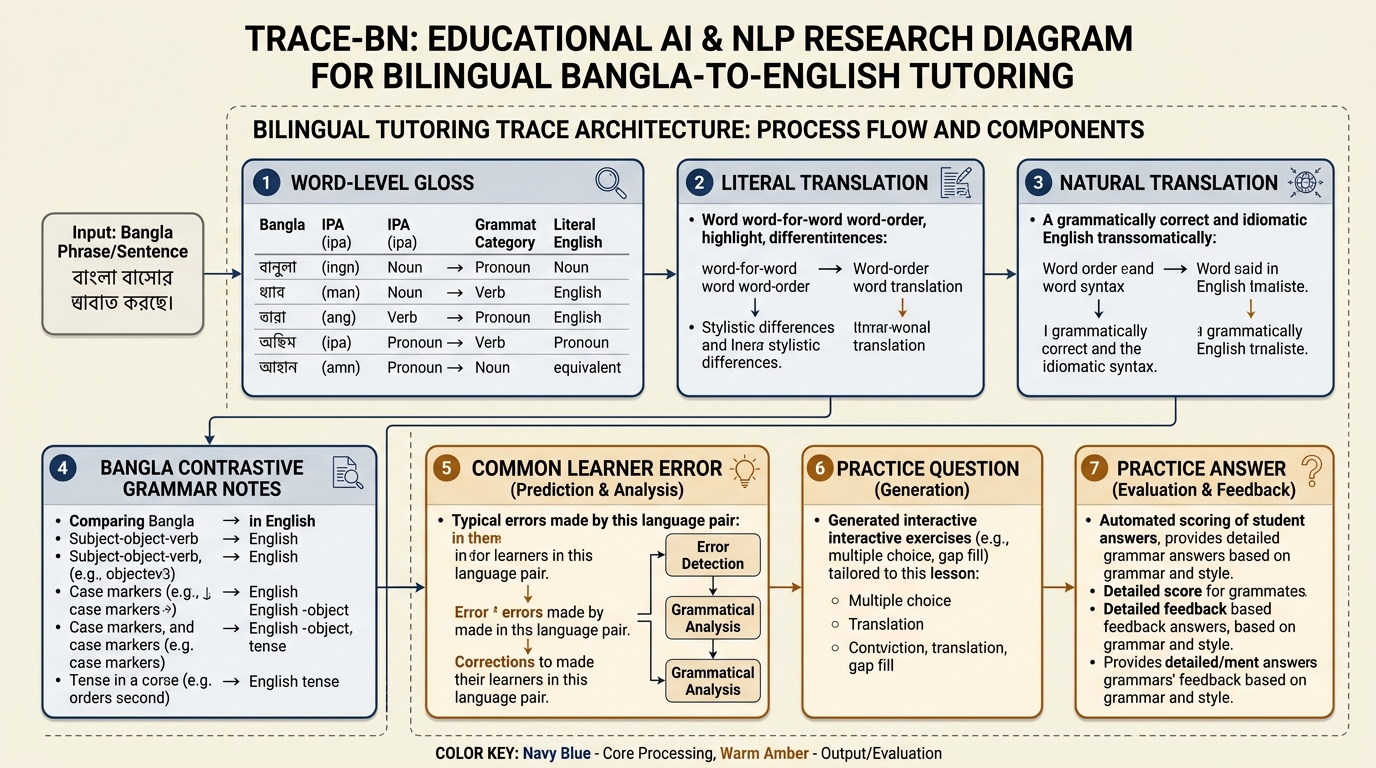
Bangla-English tutoring requires more than producing a correct translation: learners also need explanations of grammar differences, awareness of their likely errors, and targeted practice. We present TRACE-BN, a curriculum-guided dataset of 4,099 structured tutoring traces for Bangla-speaking learners of English at the CEFR A1–A2 level across 13 NCTB grammar units and 15 situational domains. Each trace encodes seven multi-task fields: word-level glosses, literal translation, natural translation, Bangla contrastive grammar notes, a common learner mistake, a practice question, and its answer. We transfer this multi-component tutoring behavior to Qwen3-0.6B using LoRA with 4-bit quantization (378.3 MB GGUF) for offline, on-device deployment. On 432 held-out examples, schema validity improves from 85.4% to 95.8%, chrF++ rises from 15.28 to 34.77 (+19.49 gain), and BLEU increases from 4.52 to 21.03, supported by dual automated judges and a 100-trace educator audit (4.71/5.00 overall rating).
Key Empirical Receipts & Quantitative Highlights
- 4,099 curriculum-guided 7-field structured tutoring traces based on NCTB Classes 9–10 English curriculum (CEFR A1–A2).
- Transfers structured tutoring behavior to a sub-1B model (Qwen3-0.6B) deploying at 378.3 MB GGUF (75.47 tokens/sec).
- Schema validity increases from 85.4% to 95.8%; chrF++ improves by +19.49 (15.28 → 34.77) and BLEU from 4.52 to 21.03.
- Trace component ablation shows that full 7-field structured supervision boosts translation quality over translation-only training.
- 100-trace educator audit confirms 95.7% of supervision traces rated ≥ 4/5 across translation, grammar, and learner error plausibility.
Problem Context & Real-World Motivation
Language learners in low-connectivity rural schools across Bangladesh lack access to dedicated private English tutors. However, standard translation models only provide output strings without pedagogical scaffolding. An effective bilingual tutor must explain grammatical divergence (e.g. Bengali SOV vs English SVO), diagnose common L1-interference mistakes, and supply instant practice exercises—all executing locally on cheap offline smartphones without costly cloud API dependencies.
Principal Research Contributions
Authored TRACE-BN, a 4,099-trace curriculum-guided dataset for Bangla-to-English tutoring aligned with NCTB secondary textbooks (CEFR A1–A2).
Formulated a 7-component structured pedagogical trace schema (word glosses, literal translation, natural translation, contrastive grammar, common mistake, practice question, practice answer).
Fine-tuned Qwen3-0.6B with 4-bit LoRA on a single consumer GPU, generating a 378.3 MB GGUF quantized model running at 75.47 tok/sec locally.
Demonstrated via ablation that training models on full multi-task pedagogical structures improves underlying translation fidelity compared to translation-only training.
Dataset Construction, Taxonomy & Verification
4,099 structured bilingual tutoring traces (3,667 train, 432 held-out evaluation)
Curriculum-stratified split by topic cluster and NCTB grammar chapter
Bengali-English Bilingual Language Acquisition (CEFR A1–A2)
NCTB English Curriculum for Classes 9–10 across 13 grammar units and 15 situational domains
100-trace educator audit by 3 bilingual English language teachers (4.71/5.00 mean rating; 95.7% rated ≥4)
Task Breakdown & Evaluation Tracks
Word-Level Glosses
Token-by-token alignment pairing Bengali words with English translations and Part-of-Speech tags.
Literal vs. Natural Translation
Exposes structural word-order divergence (SOV to SVO) alongside idiomatic, natural English target phrasing.
Contrastive Grammar Notes
Bengali-medium pedagogical notes highlighting tense, prepositions, articles, and auxiliary verb usage.
Common Learner Mistake & Diagnostic
Anticipates high-frequency Bengali L1 transfer errors (e.g. omitting copula verbs or preposition mismatch).
Targeted Practice & Solution
Auto-generated fill-in-the-blank or transformation exercise testing the exact grammar concept introduced.
Experimental Setup & Benchmarked Models
LoRA rank r=16, alpha=32; 4-bit Unsloth quantization; 3 epochs on Colab T4 (16GB); greedy decoding.
Single Google Colab Nvidia T4 (16GB); quantized inference measured on edge CPU with llama.cpp.
Schema validity % (strict JSON parse), chrF++, BLEU-4, and dual LLM-judge 0–4 pedagogical rating.
Quantitative Evaluation Results & Baselines
Table 1: Benchmark Performance on Held-Out Test Set (n=432 examples)
| Model | Parameters | Schema Validity % | chrF++ ↑ | BLEU-4 ↑ | Edge Throughput (tok/s) |
|---|---|---|---|---|---|
| Gemma-4 E2B (Zero-Shot) | 2.3B | 90.5% | 50.91 | 33.54 | 45.97 |
| TigerLLM-1B (Bangla Tuned) | 1.0B | 67.1% | 22.23 | 8.21 | 48.79 |
| Llama-3.2-1B-Instruct | 1.0B | 12.7% | 13.21 | 1.95 | 73.11 |
| Qwen3-0.6B (Untuned Base) | 0.6B | 85.4% | 15.28 | 4.52 | 90.89 |
| Qwen3-0.6B (TRACE-BN Tuned) | 0.6B | 95.8% | 34.77 | 21.03 | 75.47 |
Table 2: Trace Component Ablation (Evaluating Translation Fidelity Under Varied Supervision)
| Training Configuration | Target Supervised Fields | Schema Validity % | chrF++ Score |
|---|---|---|---|
| Translation Only | 1 field (Plain String) | N/A | 31.84 |
| Translation + Grammar Explanation | 2 fields (JSON Schema) | 91.2% | 33.12 |
| Full TRACE-BN (Ours) | All 7 pedagogical fields | 95.8% | 34.77 (+2.93 gain) |
Diagnostic Error Analysis & Failure Modes
A sub-1B model (Qwen3-0.6B) can internalize complex, multi-task pedagogical schemas when structured data constraints are enforced during tuning. Remarkably, supervising contrastive grammar notes and learner error diagnostics provides auxiliary regularization that boosts core translation quality by +2.93 chrF++ over translation-only training.
Zero-Shot Schema Collapse in Multilingual Small Models
Untuned Llama-3.2-1B produces 87.3% schema failures, failing to close JSON brackets or emitting conversational preambles.
L1 Negative Transfer Overlooked by Generic MT
Standard translation models translate "Ami bhat khai" correctly as "I eat rice", but fail to point out to the student that Bengali places the verb at the end (Subject-Object-Verb), which causes students to write "I rice eat".
Practical Significance & South Asian AI Implications
Provides a deployable blueprint for offline digital educational equity. The 378.3 MB GGUF weight can be embedded directly into low-end Android mobile apps or Raspberry Pi classroom devices across rural Bangladesh.
Open-Access Research Artifacts
TRACE-BN Dataset (Hugging Face)
4,099 curriculum-aligned JSON traces
LoRA Adapter & GGUF Quantized Checkpoint
378.3 MB model ready for llama.cpp
arXiv Preprint
Full 14-page manuscript under double-blind review
BibTeX Citation (Preprint)
@article{reza2026tracebn,
  title={TRACE-BN: Transferring Bangla-English Tutoring Behavior to a Sub-1B Offline Language Model},
  author={Reza, Khan Raiyan Ibne and others},
  journal={arXiv preprint arXiv:2608.15223},
  year={2026}
}