Manuscript under review at EACL 2027 System Demonstrations; acceptance has not been confirmed.
KrishokTech: A Bengali Agricultural Advisory System with Explicit Authorization Controls
Abstract
For agricultural advisory, generating an answer is only part of the problem: the system must also control unsafe requests, work with limited connectivity, and accommodate changing guidance. KrishokTech is a Bengali agricultural advisory system built around an explicit authorization boundary around generation. Before retrieval, normalization and rule-based admission checks refer policy-covered high-risk requests and ask for a crop when treatment intent is underspecified. The system then binds retrieval to a single crop and asks for confirmation when the text and image indicate different crops. After generation, a narrow verifier removes dosage claims not supported by retrieved BARI/BRRI evidence. Agricultural guidance is kept in an external evidence index that can be updated without retraining the generator, while browser-side vision and local retrieval reduce connectivity requirements. The interface makes these decisions visible as ASK, CONFIRM, REFER, and DROP, together with their evidence. On 200 farmer queries and 400 stress queries, the controls halted underspecified requests and reduced cross-crop retrieval violations from 36.5% to 0% under the tested alias filter. Mismatch detection caught 453 of 454 text–image conflicts, while the verifier caught 114 of 118 inserted dosage errors. The demonstration shows how these controls govern the path from request to delivered advice.
How the system works
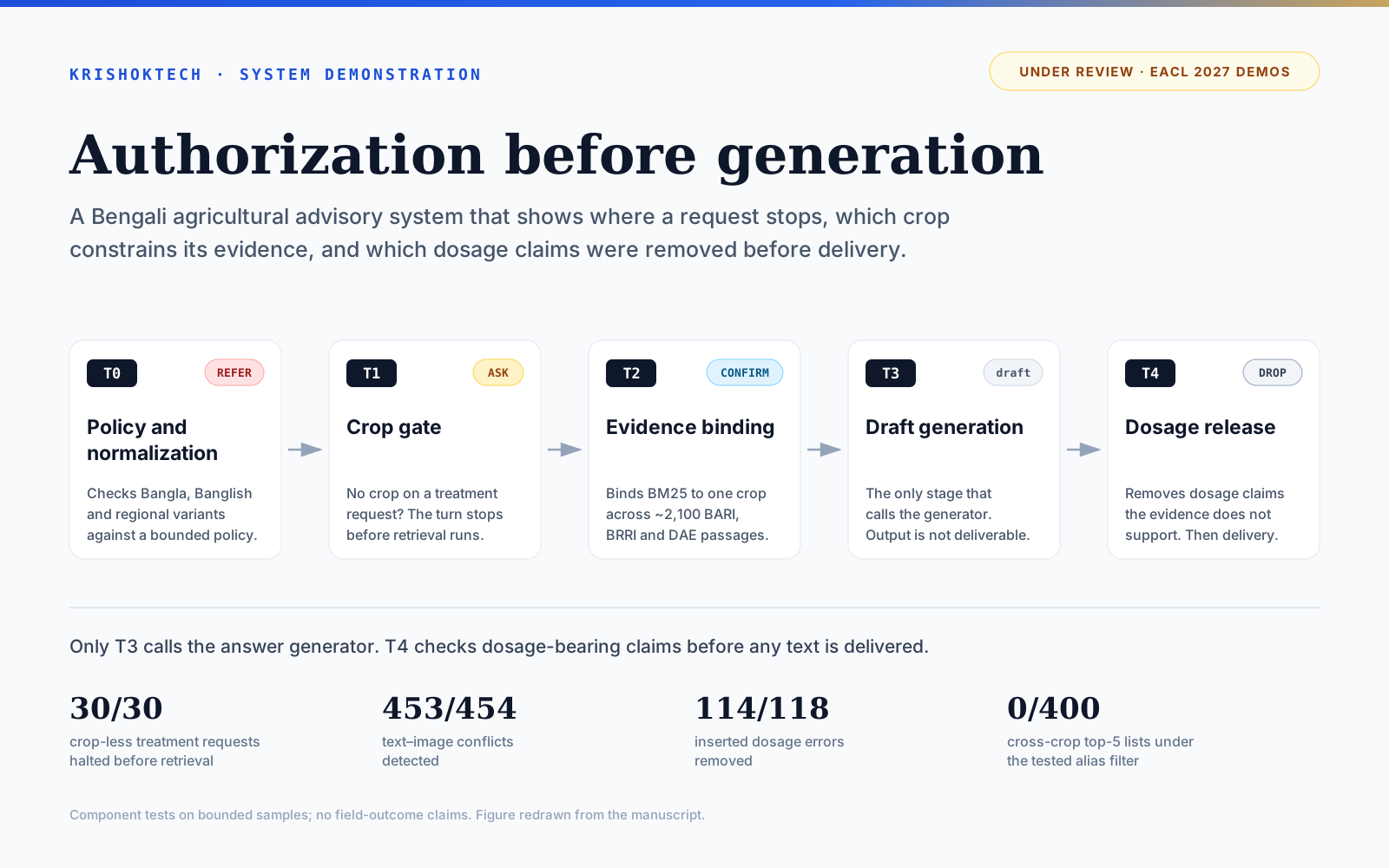
A request moves left to right. Any stage can end the turn with a visible outcome; otherwise the request continues. The draft produced at T3 is not deliverable until T4 has checked its dosage claims.
Policy and normalization
Normalizes Bengali, Banglish, and supported regional variants, then checks the request against a bounded high-risk policy.
Crop gate
Identifies crop, growth stage, location, intent, and symptoms without a language model. A treatment request with no crop stops here.
Evidence binding
Scopes BM25 retrieval to one crop across roughly 2,100 BARI, BRRI, and DAE passages. Conflicting text and image crops stop for a decision.
Draft generation
The replaceable generator receives the normalized request and crop-scoped passages. Its output is an unverified draft, not an answer.
Dosage release
Removes dosage-bearing sentences that the retrieved passage or the permitted BARI/BRRI range does not support. The remaining text may be delivered.
ASK
The request is missing a crop. The interface asks the farmer to choose or type one, and no evidence is retrieved yet.
CONFIRM
Text and photograph point to different crops. Chemical advice is withheld until the farmer selects one.
REFER
A policy-covered high-risk request stops before retrieval or generation and is routed to a human service (16123, or 999 for emergencies).
DROP
A dosage claim is unsupported or outside the permitted range, so that sentence is removed before delivery.
Key Empirical Receipts & Quantitative Highlights
- T1 halted all 30 crop-less treatment questions in a 200-query farmer set and passed all 170 crop-specified questions before retrieval.
- Normalization raised T0 interception of 85 constructed Banglish and phonetic high-risk requests from 1/85 to 85/85, while flagging none of 15 benign controls.
- Crop binding reduced cross-crop top-5 retrieval from 146/400 (36.5%) to 121/400 (30.25%); an alias-based filter removed the remaining recognized violations, and an independent title check found 26/30 lists clean.
- The mismatch state fired on 453/454 text–image conflicts (53/54 farmer-derived, 400/400 synthetic) and on none of 454 matched controls.
- Guarded prompting plus T0 replay reduced successful attacks from 147/280 to 13/280; the dosage verifier caught 114/118 inserted errors and rejected 0/38 clean answers.
- Residual misses remain: 13 of 280 attacks stayed eligible to continue, and 4 of 118 dosage errors were missed. The evaluation supports component behavior, not complete safety.
Problem Context & Real-World Motivation
A fluent answer is not the same as an authorized one. A farmer may ask which pesticide to spray without naming the crop, type the question in Banglish, or attach a photograph of a different crop. Retrieval can admit guidance for the wrong crop, and a generated sentence can state a dose that the source does not support. Each of these failures can reach the user before answer quality is even measured. KrishokTech treats them as control decisions rather than prompt instructions: the generator may draft an answer, but it does not decide whether a request may proceed or whether a dosage claim may be shown. The design keeps the generator replaceable, the evidence index updatable without retraining, and every stop visible to the farmer.
Principal Research Contributions
Places an ordered authorization boundary around a replaceable generator: T0 referral and normalization, T1 crop admission, T2 crop-scoped evidence binding and mismatch confirmation, T3 drafting, and T4 dosage release. Only T3 calls the generator.
Combines Bengali and Banglish normalization with rule-based admission, so colloquial and Latin-script requests reach the same checks as formal text; a constructed test raised T0 interception from 1/85 to 85/85 with no benign false alarms.
Binds BM25 retrieval over about 2,100 curated BARI, BRRI, and DAE passages to one crop, with browser-side crop prediction and an explicit CONFIRM state for text–image conflicts.
Adds a narrow post-generation verifier that removes dosage-bearing sentences unsupported by retrieved passages or permitted BARI/BRRI ranges, and exposes the decision through provenance badges and a Why panel.
Releases code, controls, tests, and offline-checkable evaluation results under tag v1.0.0-eacl2027, with browser-side vision models and the local generator adapter published separately.
Experimental Setup & Benchmarked Models
Component and property-conformance tests on bounded sets: 200 farmer queries, 400 stress queries, 280 fixed attacks, 118 inserted dosage errors, and 200 constructed multi-turn dialogues (425 turns).
Non-generation path measured on an evaluation laptop; local generation ran on CPU (median 24.3 s for 150 output tokens).
Halt and pass counts, cross-crop top-5 rate, text–image mismatch detection, attack success rate, and dosage-error catch rate.
Quantitative Evaluation Results & Baselines
Table 1: Main component results across bounded test sets
| Control | Test set | Result |
|---|---|---|
| T1 crop gate (C1) | 200 farmer queries | 30/30 halt; 170/170 pass |
| T0 normalization (C1) | 85 attacks, 15 benign | 85/85 caught; 0/15 flagged |
| Crop binding / filter (C2) | 400 stress queries | 146 → 121 → 0 cross-crop lists |
| Mismatch state (C2) | 54 farmer, 400 synthetic | 453/454; 0/454 controls |
| Prompt + T0 (C1) | 280 fixed attacks | 147 → 30 → 13 successful attacks |
| Dosage verifier (C3) | 118 errors, 38 clean | 114 caught; 0/38 rejected |
Table 2: Multi-turn state tests on 200 constructed dialogues (425 turns)
| Cohort | Dialogues / turns | Check | Result |
|---|---|---|---|
| Carryover | 75 / 175 | Crop slot kept | 100/100 |
| Crop shift | 75 / 150 | Slots flushed | 75/75 |
| Crop shift (same) | 75 / 150 | Old slot kept | 0/75 |
| Delayed evasion | 30 / 60 | Turn-2 catch | 30/30 |
| Clarification | 20 / 40 | ASK, then bound | 20/20 |
Diagnostic Error Analysis & Failure Modes
The controls are deliberately narrow, and the reported numbers describe component behavior on bounded samples. The informative failures sit at the edges of each rule: unseen paraphrases can pass the policy gate, the crop filter only knows the aliases it was given, and the dosage verifier only checks numerical dosage claims. These boundaries are stated with the results rather than left implicit.
Unseen wording can still pass T0
The policy precheck recognizes covered patterns rather than every paraphrase. After the guarded prompt and T0 replay, 13 of 280 attacks remained eligible to continue. That is a large reduction from 147, but it is not generator independence.
The crop filter is bounded by its alias list
The 0/400 cross-crop result holds under the tested alias filter because the filter and the metric share that list. An independent title inspection found 4 of 30 lists still naming crops outside it: carrot, sweet potato, or forest trees.
Dosage verification is not factual verification
T4 removes unsupported dosage-bearing sentences only. It caught 114 of 118 inserted errors but does not check every agronomic statement, and the errors were inserted into existing answers rather than observed naturally.
No field evidence yet
The 400 of 454 mismatch cases are synthetic, the crop-binding test assumes correct routing, and the evaluation does not measure farmer decisions, yields, or extension-service workload.
Practical Significance & South Asian AI Implications
KrishokTech shows a reusable pattern for safety-sensitive advisory systems: keep the answer generator replaceable, place explicit checks before retrieval and before release, and show every stop to the user. Guidance can be updated by rebuilding an external index rather than retraining a model, and vision plus retrieval can run locally. The current scope is six crop groups and a bounded Bengali evidence collection; adding a crop still requires evidence, aliases, routing rules, and a compatible classifier. The paper reports component tests, not field outcomes.
Open-Access Research Artifacts
Interface preview
Public UI preview of the demonstration flow
Screencast (<2.5 min)
Recorded walkthrough of S1–S5 decision states
Code, controls and tests
Released under tag v1.0.0-eacl2027; offline reproduction without API keys
Browser-side vision models
ONNX classifiers used by the local vision path
Generator adapter and evidence index
LoRA adapter and retrieval artifacts; separate model licenses apply
BibTeX Citation
@misc{reza2026krishoktech,
  title={KrishokTech: A Bengali Agricultural Advisory System with Explicit Authorization Controls},
  author={Reza, Khan Raiyan Ibne and Maria, Sanjana Aktar and Ahmed, Shakil and Hossain, Faiyad and Nimi, Sumaiya Tabassum},
  year={2026},
  note={Under review at the EACL 2027 System Demonstrations Track}
}